Discover the history of Boa Vista in Cape Verde: first inhabitants, salt trade, Sal Rei, Povoação Velha, morna, pirates, and maritime heritage.
When you think of Boa Vista in Cape Verde, the first images that come to mind are often those of long white sand beaches, the Viana Desert, and the turquoise waters of the Atlantic Ocean.
Yet behind these landscapes lies a much richer history.
For several centuries, Boa Vista lived to the rhythm of the sea, trade, salt, fishing, and migration. From the first human settlements to the rise of Sal Rei, including maritime trade, pirate attacks, the birth of cultural traditions, and Cape Verde's independence, the island still preserves many traces of its past today.
Discovering the history of Boa Vista means looking at the island in a different way: behind every village, every ruin, and every boat lies a piece of Cape Verdean history.
Boa Vista before the first human settlements
Like all the islands of Cape Verde, Boa Vista is of volcanic origin. However, along with Sal and Maio, it is one of the oldest islands in the archipelago, which explains its much more eroded, flat, and arid terrain compared to islands like Santo Antão or Fogo.
According to the Tourism Institute of Cape Verde, Boa Vista was reached by Portuguese navigators in 1460, at the beginning of European expansion in the Atlantic. The exploitation of salt, livestock farming, and commercial exchanges subsequently favored the progressive settlement of the island.
The human history of Boa Vista thus began closely linked to two elements that would continue to shape its destiny for several centuries: its natural resources and the Atlantic Ocean.
The first inhabitants of Boa Vista
Human settlement did not happen in a single step.
Historical and cultural research reported by the official tourism portal of Boa Vista indicates that from the end of the 15th century, enslaved people as well as free men were transported to the island. The encounter between different African and European populations, followed by exchanges with foreign sailors and traders, gradually contributed to the creation of a unique society and culture in Boa Vista.
This history reminds us that current Cape Verdean culture was built at the crossroads of several influences, but also within the violent context of slavery and Portuguese colonization.
Over generations, a language, traditions, music, and a Creole identity emerged that are today deeply associated with Cape Verde.
Povoação Velha, one of the historic cradles of Boa Vista
To discover this part of the island's history, Povoação Velha is a must-visit place.
Located at the foot of Rocha Estância, the village is presented by the official tourism portal of Boa Vista as the first inhabited place on the island. It was also an important center of Boa Vista and is said to have held the status of capital until 1810.
Even today, its architecture, alleyways, and church allow visitors to imagine a Boa Vista very different from that of today's large hotels and tourist infrastructure.
Above all, Povoação Velha shows that the island's history does not begin in Sal Rei: long before the development of the current capital, communities were already living in the interior and south of Boa Vista.
Rabil and the development of trade
Rabil also occupies an important place in the history of Boa Vista.
The island's official tourism portal dates its founding to the end of the 16th century and indicates that the village became a center linked notably to the salt trade and fishing.
Rabil still preserves a particularly well-known artisanal tradition today: pottery and terracotta work. This activity is among the cultural heritage elements highlighted by the Tourism Institute of Cape Verde.
Thus, when visiting a pottery workshop in Rabil today, you are not just discovering a tourist souvenir: you are coming into contact with a craft practice directly linked to the island's cultural history.
Salt: one of the great historic riches of Boa Vista
To understand the development of Boa Vista, one must talk about salt.
At a time when food preservation relied largely on salting, this resource was of major commercial importance. In the 18th century, the salt trade played an essential role in the region's economy.
Boa Vista possessed several natural areas suitable for its extraction.
The salt was then traded with other islands and various maritime destinations. This activity contributed to the development of communities in Boa Vista and gradually helped strengthen the importance of Sal Rei.
And this trade is still visible in the very name of the capital.
Why is Sal Rei called Sal Rei?
The capital of Boa Vista bears the name Sal Rei today.
This name is directly linked to the historical importance of the salt pans that surrounded the town and the exploitation of salt. The official portal of Boa Vista recalls that Sal Rei was once particularly tied to salt harvesting and livestock farming.
As maritime trade developed, Sal Rei gradually became one of the main economic centers of the island.
Merchants and political leaders settled there and built two- or three-story houses. Several traces of this era can still be observed in the town's architecture today.
Strolling through the center of Sal Rei in Boa Vista today, particularly around its squares and old houses, allows you to reconnect with a period when maritime trade occupied a central position.
An island exposed to pirates and maritime attacks
The development of trade also had a downside.
Goods, salt, and ships attracted the attention of pirates and privateers operating in the Atlantic.
Facing Sal Rei, on the islet located in the bay, Portuguese authorities established a fortification designed to protect the port and the town against attacks. The official portal of Boa Vista still mentions this fortress among the visible historical elements around Sal Rei.
This defensive presence serves as a reminder of how much the sea represented both a source of prosperity and a source of danger at that time.
In Boa Vista, land history and maritime history are almost impossible to separate.
Curral Velho, a village abandoned today
In the south of the island lie the ruins of Curral Velho, a former coastal village.
The official tourist site of Boa Vista dates the settlement from the 17th century and describes a community living mainly from fishing as well as the salt trade.
Life there was particularly harsh. Isolation, lack of drinking water during dry periods, and pirate attacks gradually contributed to the departure of its inhabitants. The village was finally abandoned in the 19th century according to the same source.
Today, the ruins of Curral Velho represent one of the most striking testimonies of Boa Vista's past.
Standing before these abandoned buildings facing the ocean, it becomes easier to imagine the hardships faced by the island's past communities.
Boa Vista and the birth of the morna
The history of Boa Vista is not limited to trade.
It is also deeply cultural.
The morna, today one of Cape Verde's great musical symbols, was inscribed in 2019 on UNESCO's Representative List of the Intangible Cultural Heritage of Humanity.
Regarding its exact origins, historical sources remain cautious. The file submitted to UNESCO mentions Boa Vista as the probable place where an early form or "proto-morna" appeared, while certain traditions also mention the island of Brava in the subsequent evolution of the genre.
The cultural portal of Boa Vista dates the appearance of this first musical form between the end of the 18th and the middle of the 19th century, linking Povoação Velha in particular to some of the earliest known mornas.
It is therefore more accurate to say that Boa Vista plays a major role in the origins of the morna, rather than presenting its birthplace as a definitively established historical fact.
This music often speaks of distance, love, the sea, departure, and sodade: themes intimately linked to the history of the Cape Verdean people.
The sea at the heart of Boa Vista's history
Fishermen, traders, navigators, and families lived for generations with the Atlantic as their horizon.
Commercial exchanges depended on ships. Fishing helped feed the population. Salt departed by boat. Travelers arrived while other inhabitants left the island.
This maritime openness brought Boa Vista into contact with different cultures and populations. The official portal of the island emphasizes the influence of international commercial exchanges and contacts with foreign peoples in shaping its sociocultural heritage.
That is why discovering Boa Vista from the sea also allows you, in a way, to get closer to its history.
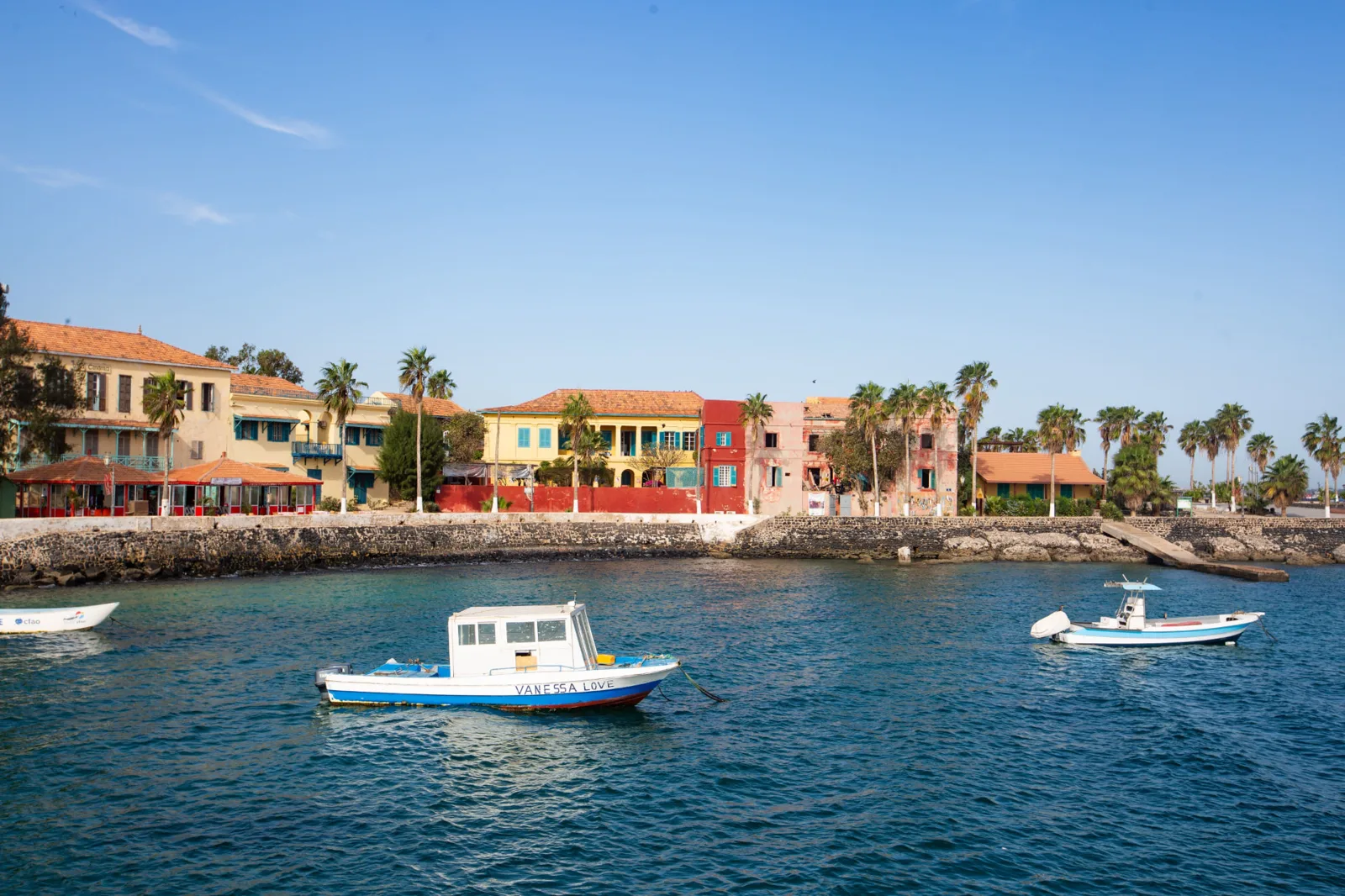
From the bay of Sal Rei, the current landscape still retains this relationship between the town, its port, its islet, and the Atlantic.
The Cabo Santa Maria: a more recent story that became iconic
Not all stories in Boa Vista go back several centuries.
On Atalanta beach lies one of the most famous symbols of the island today: the shipwreck of the Cabo Santa Maria.
The Spanish cargo ship ran aground on the shores of Boa Vista in September 1968. According to official tourist sources from the island and Cape Verde, it was carrying a large cargo when it became stranded on a sandbank.
Its cargo was gradually recovered and the wreck remained in place.
Over the decades, salt, waves, and corrosion transformed the ship into a huge rusty structure, of which only a part remains today.
This shipwreck is much more recent than other episodes in Boa Vista's history, but it has become so associated with the image of the island that it now belongs to its collective memory.
From the colonial period to Cape Verde's independence
For several centuries, Boa Vista, like the rest of the archipelago, was part of the Portuguese colonial empire.
In the 20th century, the movement for the independence of Cape Verde and Guinea-Bissau gradually gained momentum.
Following the fall of the Portuguese dictatorship in 1974 and a period of political transition, Cape Verde proclaimed its independence on July 5, 1975.
Boa Vista thus entered a new era of its history by becoming one of the islands of the independent Republic of Cape Verde.
To understand the island today, this date remains fundamental: it marks the end of several centuries of Portuguese colonial rule and the beginning of the construction of modern Cape Verde.
Boa Vista today: between heritage and tourism
Today, Boa Vista has become one of the Cape Verdean islands most closely associated with beach tourism and nautical activities. Yet its historical heritage remains visible in many places.
In Sal Rei, certain buildings recall the salt trade era. In Povoação Velha, visitors find one of the island's oldest settlement sites. In Rabil, craftsmanship reflects traditions passed down through generations. In Curral Velho, ruins bear witness to a way of life that has now disappeared. And on Atalanta beach, the Cabo Santa Maria tells a much more recent maritime story.
Boa Vista's heritage is also cultural: architecture, handicrafts, music, Creole language, traditions, and the relationship with the ocean are all part of the island's identity.
Places to visit to discover the history of Boa Vista
If you wish to go beyond the beaches during your stay, several places provide a better understanding of the island's past:
Sal Rei, for its architecture, port, salt pans, and maritime heritage; Povoação Velha, to discover one of the oldest inhabited places in Boa Vista; Rabil, especially for its handicrafts and pottery; Curral Velho, with the ruins of the old village; the islet of Sal Rei, where traces of a fortification built to protect the bay remain; Praia de Atalanta, to discover the shipwreck of the Cabo Santa Maria.
These sites show that Boa Vista is not merely a beach destination. Its territory is also the result of several centuries of exchange, migration, trade, hardship, and traditions.
Discovering Boa Vista means understanding its history
A beach may seem completely wild today even though it was once used by fishermen or traders.
A small town like Sal Rei may appear peaceful without one imagining the past importance of its maritime trade.
And a boat trip in the bay takes on another dimension when you know that these same waters have seen fishermen, traders, navigators, and ships from various horizons pass by for centuries.
The history of Boa Vista is therefore inseparable from the Atlantic Ocean.
At Marina Travel Tours, we cherish this relationship between Boa Vista and the sea. Discovering the island from the ocean not only allows you to admire its landscapes from another perspective, but also brings you closer to an element that has accompanied its entire history.
Even today, the sea remains at the heart of life in Boa Vista.
And perhaps it is by looking at the island from the ocean that one best understands why.